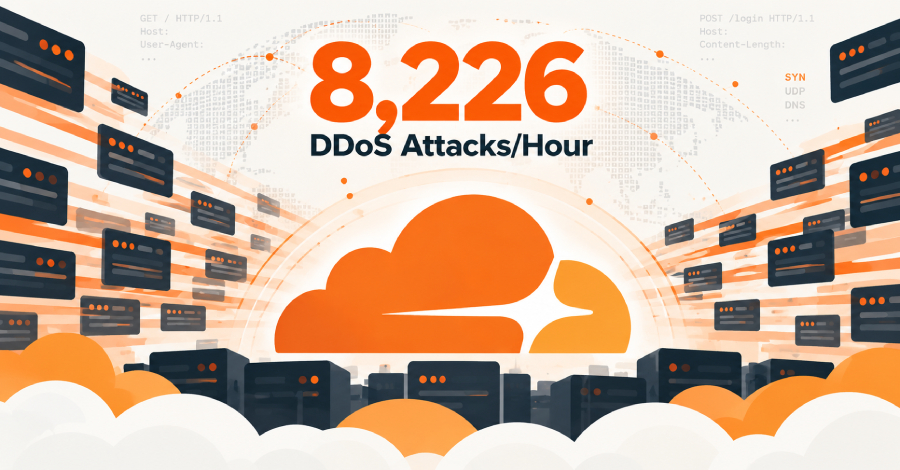
Tahdid qiluvchilar soatiga taxminan 8 226 ta tarmoq darajasidagi taqsimlangan xizmatdan rad etish (DDoS) hujumlarini amalga oshirmoqda, deb xabar berdi Cloudflare payshanba kuni.
Veb infratuzilma va xavfsizlik kompaniyasi 2026-yilning uchinchi choragida 18,2 million tarmoq darajasidagi (L3) DDoS hujumlari va 14,4 trillion HTTP DDoS so'rovlarini avtonom tarzda yumshatganini aytdi. Bu kuniga 197 400 ta hujum, yoki har 0,44 soniyada bitta hujum degani.
Taqqoslash uchun, 2026-yilning ikkinchi va birinchi choraklarida mos ravishda 13,2 million va 10,0 million L3 DDoS hujumlari qayd etilgan. O'sish yuz minglab hujumlar uchun mas'ul bo'lgan DDoS-for-hire booter yoki stresser xizmatlari bilan bog'liq.
"10 daqiqadan kam va 1 Gbps dan past bo'lgan qisqa muddatli, past o'tkazuvchanlik hujumlari 208% ga oshdi," deb aytdi Cloudforce One tahdid razvedkasi jamoasi The Hacker News bilan baham ko'rgan choraklik DDoS Tahdid Hisobotida.
Qiziqarli tendentsiya - oldingi chorakka nisbatan 1 Tbps dan oshgan gipervolumetrik hujumlarning 69% ga kamayishi - ikkinchi chorakdagi 805 ta hujumdan uchinchi chorakdagi 251 ta hujumga tushishi - ehtimol shu yilning mart oyida AISURU, KimWolf, JackSkid va Mossad ga qarshi huquqni muhofaza qilish organlari harakatlari natijasidir.
Shunga qaramay, tahdid to'liq neytrallashtirilganidan ancha uzoq, chunki Dysphoria va Evooo1Bot kabi yangi variantlar paydo bo'ldi, deb ogohlantirdi Cloudflare.
Yana bir e'tiborga molik o'zgarish - Ulanishsiz Yengil Katalogga Kirish Protokoli (CLDAP) toshqinlarining kamayishi, DNS kuchaytirish esa 215% ga sakrab, barcha tarmoq darajasidagi hujumlarning 3,43% ini tashkil etdi.
Eng ko'p nishonga olingan sohalar orasida ommaviy axborot vositalari, ishlab chiqarish va nashriyot; axborot texnologiyalari va xizmatlari; qimor va kazinolar; kompyuter dasturiy ta'minoti; va telekommunikatsiya provayderlari bor.
AQSh, Xitoy, Indoneziya, Buyuk Britaniya va Turkiya ushbu davrda eng ko'p hujumga uchragan davlatlar sifatida paydo bo'ldi, Kanada va Isroil esa Kanadaning chakana savdo, telekommunikatsiya va marketing sohalariga qaratilgan hujumlar tufayli top 10 reytingiga kirdi.
Threat actors are launching about 8,226 network-layer distributed denial-of-service (DDoS) attacks per hour, Cloudflare revealed Thursday.
The web infrastructure and security company said it autonomously mitigated 18.2 million network-layer (L3) DDoS attacks and 14.4 trillion HTTP DDoS requests in the third quarter of 2026. That amounts to 197,400 attacks per day, or one attack every 0.44 seconds.
In comparison, a total of 13.2 million and 10.0 million L3 DDoS attacks were recorded in Q2 and Q1 2026, respectively. The increase has been linked to DDoS-for-hire booter or stresser services that are responsible for hundreds of thousands of attacks.
"Short-burst, low-bandwidth attacks lasting under 10 minutes and 1 Gbps surged by 208%," the Cloudforce One threat intelligence team said in its quarterly DDoS Threat Report shared with The Hacker News.
An interesting trend is the decline of hyper-volumetric attacks exceeding 1 Tbps by 69% from the previous quarter – going from 805 attacks in Q2 to 251 in Q3 – likely as a result of law enforcement actions against AISURU, KimWolf, JackSkid, and Mossad earlier this March.
Still, the threat remains far from completely neutralized, given the emergence of new variants like Dysphoria and Evooo1Bot, Cloudflare warned.
Another notable shift is the decline in Connectionless Lightweight Directory Access Protocol (CLDAP) floods, while DNS amplification jumped 215% to account for 3.43% of all network-layer attacks.
The most targeted industries include media, production, and publishing; information technology and services; gambling and casinos; computer software; and telecommunications providers.
The U.S., China, Indonesia, the U.K., and Türkiye emerged as the most attacked countries during the time period, with Canada and Israel entering the top 10 ranking, fueled by attacks targeting Canada's retail, telecommunications, and marketing sectors.
Found this article interesting? Follow us on Google News, Twitter and LinkedIn to read more exclusive content we post.