Google chorshanba kuni Gemini 4 Carbon'ni taqdim etdi, bu uning eng so'nggi chegara modeli bo'lib, zamonaviy kiberxavfsizlik va uzoq muddatli qobiliyatlarga ega.
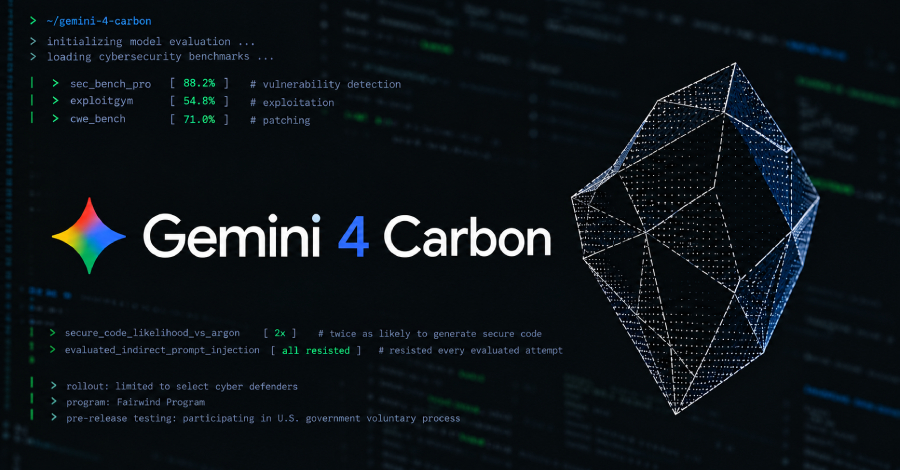
"U kodlash va agentlik vazifalari bo'yicha, shuningdek, kiberxavfsizlik himoyasi uchun muhim bo'lgan asosiy qobiliyatlar bo'yicha sezilarli yutuqlarga erishdi, zaifliklarni topishda SEC-bench Pro (88,2%), ekspluatatsiyada ExploitGym (54,8%) va tuzatishda CWE-bench (71,0%) bo'yicha mustahkam yetakchilikni qo'lga kiritdi," dedi Google DeepMind katta vitse-prezidenti va Google bosh AI arxitektori Koray Kavukcuoglu.
Artificial Analysis Intelligence Index benchmarkida Carbon 59 ball bilan yetakchilik qilmoqda, Anthropic'ning Claude Opus 5.5 (58), OpenAI GPT-6 Astra (57), GPT-6.1 Sol (55) dan yuqori.
Asosiy yo'nalishlardan biri kiberxavfsizlik bo'lib, so'nggi iteratsiya zaifliklarni aniqlash, tasdiqlash va tuzatish bo'yicha keng ko'lamli sezilarli ishlash yaxshilanishlarini taqdim etadi. Carbon, shuningdek, Argon bilan solishtirganda xavfsiz kod yaratishda ikki baravar ko'proq ehtimolga ega.
Google, shuningdek, Carbon murakkab yoki yuqori bosimli vazifalarga noaniqlik oldida "taxmin qilish yoki yo'lni majburlash" o'rniga inson fikrini izlash orqali javob berishga harakat qilishini, shuningdek, bilvosita prompt in'ektsiyasining har bir baholangan hujum urinishiga qarshi turishini ta'kidladi.
Gemini 4 Carbon'ning debyuti texnologiya giganti Gemini 4 Argon'ni taqdim etganidan bir haftadan kamroq vaqt o'tib sodir bo'ldi. Chiqarish rejasi o'zidan oldingisiga o'xshash bo'lib, hozirda Fairwind dasturi doirasida boshqa ishonchli hamkorlarga kirishni kengaytirishdan oldin kiber himoyachilarning kichik guruhiga cheklangan.
Google, shuningdek, AQSh hukumatining modelni oldindan sinovdan o'tkazish bo'yicha ixtiyoriy jarayonida faol ishtirok etayotganini aytdi.
Bu rivojlanish OpenAI GPT-6.1 Terra'ni e'lon qilgan paytda sodir bo'ldi, u buni tez, samarali model deb ta'rifladi, "muloqot va kompyuterga asoslangan vazifalarda a'lo natija beradi."
"GPT-6.1 Terra bizning Tayyorlik doiramiz doirasida kiberxavfsizlikda Kritik chegaraga yetadi va GPT-6 Astra uchun ishlab chiqilgan himoyalarni saqlab qoladi," dedi OpenAI.
"GPT-6.1 Terra o'zi bilan GPT-6 seriyasining moslashuv yaxshilanishlarini olib keladi. Bizning baholashlarimizga ko'ra, GPT-6.1 Terra GPT-5.6 Terra bilan solishtirganda doirada qolish va foydalanuvchiga cheklovlar va potentsial to'siqlarni halol ravishda oshkor qilish ehtimoli yuqoriroq. Bizning prompt-in'ektsiya sinovlarimizda GPT-6.1 Terra, shuningdek, foydalanuvchining vazifasidan chalg'itish uchun mo'ljallangan zararli ko'rsatmalarga kuchli qarshilik ko'rsatdi."
Shu haftaning boshida raqib Anthropic, shuningdek, hali e'lon qilinmagan ichki tadqiqot modeli dunyodagi eng keng tarqalgan dasturiy ta'minotda muhim zaifliklarni aniqlaganini ma'lum qildi.
Bunga Google Chrome'dagi bir marta bosish bilan masofaviy kod bajarilishi, Apple Safari'dagi bir marta bosish bilan ekspluatatsiya zanjiri (bu foydalanuvchining ko'rish tarixi, cookie fayllari va boshqa maxfiy ma'lumotlarga kirish uchun ishlatilishi mumkin), Android qulf ekrani aylanib o'tishi va Windows HTTP.sys drayveridagi xizmatdan rad etish (DoS) zaifligi (CVE-2026-33096, CVSS balli: 7,5) kiradi. Aniqlangan barcha muammolar Google, Apple va Microsoft tomonidan tuzatilgan.
"Bu hujum zanjirlari modelning ochiq manbali va xususiy dasturiy ta'minotda murakkab, ko'p bosqichli ekspluatatsiyalarni yaratish qobiliyatini namoyish etadi," dedi Anthropic.
"Bu ko'nikmalar tarixan bu maqsadlarda tajribaga ega bo'lgan kam sonli mutaxassis jamoalarning sohasiga tegishli bo'lgan. Endi bu modellar kam inson ishtiroki bilan qila oladigan narsa, keyin esa har kim ishlatishi va tekshirishi mumkin bo'lgan ishlaydigan ekspluatatsiya yaratish orqali isbotlash mumkin."
Ushbu maqola qiziqarli deb topdingizmi? Biz e'lon qiladigan ko'proq eksklyuziv kontentni o'qish uchun bizni Google News, Twitter va LinkedIn'da kuzating.
Google on Wednesday took the wraps off Gemini 4 Carbon, its latest frontier model with state-of-the-art cybersecurity and long-horizon capabilities.
"It shows significant gains across coding and agentic tasks as well as across key capabilities critical for cybersecurity defense, landing a firm lead in SEC-bench Pro (88.2%) for finding vulnerabilities, ExploitGym (54.8%) for exploitation, and CWE-bench (71.0%) for patching," Koray Kavukcuoglu, senior vice president of Google DeepMind and chief AI architect at Google, said.
On the Artificial Analysis Intelligence Index benchmark, Carbon leads with a score of 59, surpassing Anthropic's Claude Opus 5.5 (58), OpenAI GPT-6 Astra (57), GPT-6.1 Sol (55).
One of the core focus areas is cybersecurity, where the latest iteration reportedly delivers significant performance improvements across the board, including vulnerability detection, validation, and remediation. Carbon is also twice as likely to generate secure code versus Argon.
Google also emphasized that Carbon attempts to respond to complex or high-pressure tasks by seeking human input in the face of ambiguity rather than "guessing or forcing a path forward," as well as resisting every evaluated attack attempt at indirect prompt injection.
The debut of Gemini 4 Carbon comes less than a week after the tech giant unveiled Gemini 4 Argon. The release plan is similar to that of its predecessor, with the rollout currently limited to a subset of cyber defenders before expanding access to other trusted partners as part of its Fairwind Program.
Google also said it's actively engaged in the U.S. government's voluntary process for pre-release model testing.
The development comes as OpenAI released GPT-6.1 Terra, which it described as a fast, efficient model that "excels at communication and computer-based tasks."
"GPT‑6.1 Terra meets the Critical threshold in cybersecurity under our Preparedness Framework, and maintains the protections developed for GPT‑6 Astra," OpenAI said.
"GPT-6.1 Terra brings with it the alignment improvements of the GPT-6 series. According to our evaluations, GPT-6.1 Terra is more likely to stay within scope and honestly disclose limitations and potential blockers to the user compared to GPT-5.6 Terra. In our prompt-injection tests, GPT-6.1 Terra also showed strong resistance to malicious instructions designed to divert it from the user's task."
Earlier this week, rival Anthropic also disclosed that an unreleased, internal research model uncovered critical vulnerabilities in some of the world's most widely used software.
This included a one-click remote code execution in Google Chrome, a one-click exploit chain in Apple Safari that could be used to access a user's browsing history, cookies, and other sensitive data, an Android lock screen bypass, and a denial-of-service (DoS) flaw in the Windows HTTP.sys driver (CVE-2026-33096, CVSS score: 7.5). All the identified issues have been fixed by Google, Apple, and Microsoft.
"These attack chains demonstrate the model's ability to create sophisticated, multi-step exploits in both open-source and proprietary software," Anthropic said.
"These skills have historically been the domain of few specialist teams with expertise in these targets. Now, it’s something models can do with little human involvement, and then prove by producing a working exploit that anyone can run and verify."
Found this article interesting? Follow us on Google News, Twitter and LinkedIn to read more exclusive content we post.